
Why receive an initiation?
Receiving a Reiki initiation is not about learning a simple technique that you reproduce mechanically from a website or a PDF.
It is about answering an impulse: to slow down, to connect with what moves us deeply, and to discover a gentler, more conscious way of taking care of ourselves and others.
An initiation is first of all a time of sharing: you receive a living transmission, beyond words, which opens a door within yourself.
This is not magic or mysticism, but a passing of the torch that invites each person to feel and welcome universal energy in their daily life.
I can't do a headstand! Don't worry, this is not a yoga class. We are working with energy, not physical postures!
Are there any prerequisites?
None. You do not need to have practised any energy or spiritual discipline before. There is no notion of a "gift".
All that matters is a sincere wish to give yourself some time, to relax, to free yourself from inner tension, and to make room for more peace and ease in your life.
Reiki is accessible to everyone, whatever their age, history or beliefs.
What is the point of receiving an initiation?
The initiation gives everyone the ability to practise on themselves: to ease stress, to support the balance of body and mind, and to accompany more difficult times in life — emotional blockages, conflict, dependencies, or simply fatigue and a loss of momentum. It also makes it possible, if you wish, to share Reiki with those close to you, with respect and simplicity. As you practise, experience deepens, confidence grows, and everyone moves forward at their own pace — with no obligation to go further, but with a door opened that never closes again.
In practice, what do you learn?
During the initiation you discover the foundations of Reiki as passed on by Mikao Usui.
- Times of meditation to quieten the mind and develop inner listening.
- The self-treatment protocol, to take care of yourself every day.
- How to give a session to another person, effortlessly, letting the energy flow where it is needed.
- Understanding and integrating the fundamental principles of Reiki with the heart (and not just with the mind!).
- Over two days: posture, philosophy, meditations, hand positions… and above all, the Initiation, which opens the way.
Initiation here takes place in person: the meeting between teacher and participant makes this vibrational transmission unique.
contact course calendarSometimes we can feel alone in our practice, with questions on our mind.
Sometimes we would like to find group work again, or take time to talk without necessarily receiving an individual session.
You may get lost in the hand positions, be puzzled by certain sensations, or simply want to share your experience: further-practice meetings are held regularly, at your convenience.
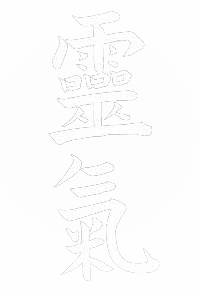
the YHE symbol (the kanji for Reiki)
THE DEGREES OF REIKI
The teaching is structured in several stages. These degrees correspond to an integration of the practice, to individual experience and, little by little, to everything that raises each person's "vibrational level".
Time and humility cannot be tamed quickly. While it seems hard to me to claim to open a practice after a First or Second Degree course, nothing prevents you from laying on hands and letting Reiki arise and flow.
There is no obligation to follow the whole path: each degree is complete in itself.
For some, the First Degree will already be very intense and "enough".
The Second Degree is the heart of Reiki. The Third Degree brings Alignment, the Fourth enables teaching.
First Degree – Shoden (the foundations)
• Hand positions on yourself and on others.
• The physical body.
• Four reiju.
• Becoming a channel.
• Daily self-practice.
👉 Open to everyone.
Detailed outline — First Degree
Course outline – First Degree
Day 1
- 1. Welcome round — 30-40 min
- 2. Energy circle — 15 min
- 3. Background and history of Reiki — 20-30 min
- 4. Meditation: Kyō dake wa — here and now — 15 min
- 5. The Gokai — reciting and anchoring the 5 precepts — 20 min
- 6. Meditation: Oubaitōri — every flower has its season
- 7. Three mudras — sensing exercises — 20 min
- 8. Feeling energy between the hands — 15 min
- 9. Self-treatment positions — 45 min
- Discussion and feedback
- Lunch break — 60 min
- 10. Inner journey meditation (body scan) — 15 min
- 11. Reiju — individual initiation — 20-30 min / student
- 12. Meditation: Toki wa kane nari — time is a treasure — 15 min
- Break
- 13. Reiji Hō – First Degree practices to begin a treatment — 10-15 min
- Gasshō — joined-hands meditation — 15 min
- Reiji Hō — inner guidance — 10-15 min
- Byōsen Reikan Hō — sensing areas of disharmony
- 14. Positions on others — 90 min
- Advice and preparing a session – discussion & sensations
Day 2
- 1. Energy circle and review of the Gokai — 15 min
- Review of self-treatment — questions
- 2. Introduction to the Hatsurei Hō meditation — 15 min
- 3. Guided Hatsurei Hō meditation — 15 min
- 4. Reiju — individual initiation — 20-30 min / student
- 5. Meditation: Isogaba maware — the right detour
- Break
- 6. Energy functions of the chakras — 20-30 min
- 7. Overview of the 3 degrees of Reiki — 15 min
- 8. Review: self-treatment / main positions
- Lunch break — 60 min
- 9. Meditation: Mateba kairo no hiyori ari — waiting for a fair wind — 20 min
- 10. Hand positions on others — long practice — 120 min
- 11. Closing meditation — 15 min
- Close of the course, personalised certificates, final sharing
Second Degree – Okuden (the inner teaching)
• Three symbols.
• Reiki at a distance / across time.
• Emotions / mind.
• Intuition.
👉 A pivotal level.
Detailed outline — Second Degree
Course outline – Second Degree
Day 1
- 1. Welcome round — 30-40 min
- 2. Energy circle — 15 min
- 3. Looking back at the First Degree and how the notion of channel evolves — 20-30 min
- 4. Meditation: presence, intention and non-willing — 15 min
- 5. Reiju — individual initiation — 20-30 min / student
- 6. Integration meditation — 15 min
- 7. Introducing the first symbol — meaning, drawing, energetic function — 30-40 min
- 8. Kotodama of the first symbol — listening, pronunciation, resonance — 10-15 min
- 9. Meditation on the first symbol — 15 min
- 10. Practising the first symbol — 30-40 min
- 11. Introducing the second symbol — meaning, drawing, mental and emotional function — 30-40 min
- Lunch break — 60 min
- 12. Kotodama of the second symbol — listening, pronunciation, resonance — 10-15 min
- 13. Meditation on the second symbol — 15 min
- 14. Practising the second symbol — mental and emotional harmonisation — 45-60 min
- 15. Kotodama in Second Degree practice — vibration, information, quality of presence — 20-30 min
- Break
- 16. Combined practice of the first two symbols — 60-75 min
- 17. Meditation: expecting no result — 15 min
- Discussion and feedback
Day 2
- 1. Energy circle and review of the Gokai — 15 min
- 2. Introduction to the Hatsurei Hō meditation — 15 min
- 3. Guided Hatsurei Hō meditation — 15 min
- 4. Sharing the previous day's experiences — 20-30 min
- 5. Reiju — individual initiation — 20-30 min / student
- 6. Integration meditation — 15 min
- 7. Introducing the third symbol — relationship, distance, continuity of awareness — 40-50 min
- 8. Kotodama of the third symbol — listening, pronunciation, resonance — 10-15 min
- 9. Meditation on the third symbol — 15 min
- Break
- 10. Distance work — principles, inner stance, practical exercises — 60-90 min
- 11. Programming a crystal — intention, information, crystalline support — 45-60 min
- Lunch break — 60 min
- 12. Meditation: information, intention and support — 15 min
- 13. Full treatment with the symbols — long practice — 90-120 min
- 14. Reiji Hō at Second Degree — refining inner listening — 15-20 min
- 15. Final meditation: letting it work — 15 min
- Close of the course, personalised certificates, final sharing
Third Degree – Shinpiden (inner Mastery)
• The Master symbol (Dai Ko Myo).
• The spiritual dimension.
• Work on oneself.
👉 Inner transformation.
Detailed outline — Third Degree
Course outline – Third Degree (Shinpiden)
Day 1
- 1. Welcome round — 30-40 min
- 2. Energy circle — 15 min
- 3. Looking back on the path so far — First and Second Degrees, experiences and integration — 20-30 min
- 4. Meditation: silence and inner availability — 15 min
- 5. Reiju — individual initiation — 20-30 min / student
- 6. Integration meditation — 15 min
- 7. Introducing the Master symbol — Dai Ko Myo — meaning, drawing, spiritual scope — 40-50 min
- 8. Kotodama of the Master symbol — listening, pronunciation, resonance — 15 min
- 9. Meditation on the Dai Ko Myo — 20 min
- Lunch break — 60 min
- 10. The spiritual dimension of Reiki — the lineage, Mikao Usui, living transmission — 30-40 min
- 11. Working on the deep layers — memories, inner patterns, release — 45-60 min
- 12. Practising the Dai Ko Myo in self-treatment — 30 min
- Discussion and sharing of experiences
Day 2
- 1. Energy circle and review of the Gokai — 15 min
- 2. Hatsurei Hō in depth — 20 min
- 3. Guided meditation: meeting oneself — 20 min
- 4. Reiju — individual initiation — 20-30 min / student
- 5. Integration meditation — 15 min
- 6. Reiki as a spiritual path, without dogma — discussion — 30 min
- Break
- 7. Combined practice of the three symbols and the Dai Ko Myo — full treatment, long practice — 90-120 min
- Lunch break — 60 min
- 8. Practitioner ethics — stance, responsibility, appropriate boundaries — 30 min
- 9. Towards teaching — what becoming a master teacher involves, an opening without entering into the content of the Fourth Degree — 20 min
- 10. Final meditation: the light I carry — 15 min
- Close of the course, personalised certificates, final sharing
Access to the Second and Third Degrees is possible if previous initiations were received elsewhere, with a case-by-case refresher.
Integration period: 3 to 6 months / 6 to 12 months.

Every course takes place in a quiet setting, with cold and hot drinks provided. Teaching, initiations, meditations, times for sharing, contact with nature.
Courses are run in small groups (6 maximum) and, on request, individually or for couples.
Each degree comes with a printed and PDF manual, free access to the online meditations and personal follow-up by email.
contact course calendar